
Most growing businesses don't have a software problem. They have a repetition problem: the same data typed into two places, the same follow-up email sent by hand, the same report rebuilt every Friday.
Our rule of thumb is simple: if it repeats, it can probably be automated. Below are five processes worth looking at first, and a way to decide which one to start with.
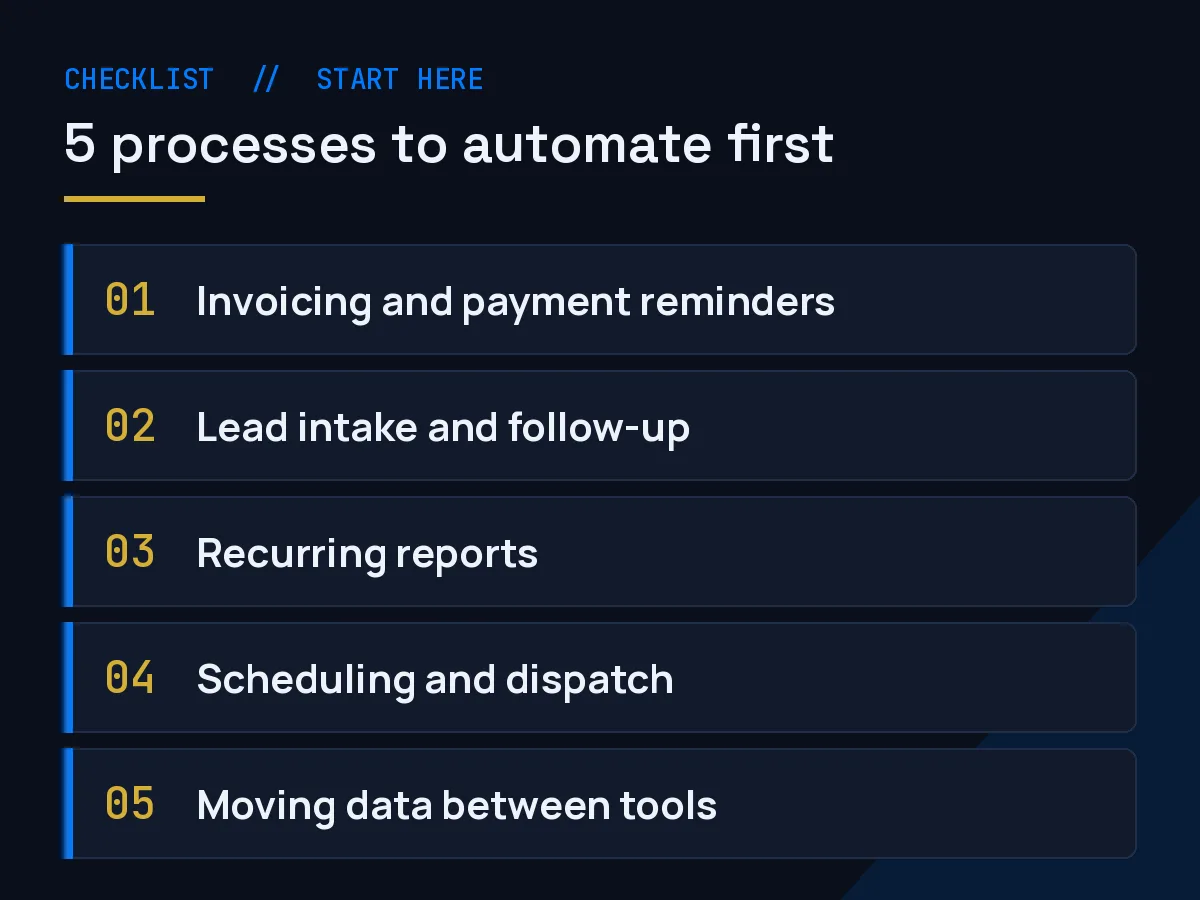
1. Invoicing and payment reminders
Creating an invoice from a finished job, sending it and chasing late payments is predictable work. A system can generate the invoice when the job closes, send it, and follow up on a schedule. A person only steps in when a payment is truly overdue.
What you get: fewer forgotten invoices and less time spent chasing.
2. Lead intake and follow-up
When an inquiry comes in by form, email or phone, it should land in one place, get an immediate acknowledgment, and trigger a follow-up if nobody replies. Leads rarely get lost because of bad intentions. They get lost because the process lives in someone's inbox.
What you get: every inquiry logged, answered and tracked.
3. Recurring reports
If someone copies numbers from three tools into a spreadsheet every week, that report can be built from live data and delivered automatically. The person who used to assemble it can spend that time reading it.
What you get: the same report, on time, without the weekly rebuild.
4. Scheduling and dispatch
Confirmations, reminders, reschedules and technician assignments follow rules. Rules can be automated. People handle the exceptions: the emergency call, the customer who needs a different day.
What you get: fewer no-shows and fewer back-and-forth messages.
5. Moving data between tools
Typing the same customer or order information into your CRM, your accounting software and your spreadsheet is the most common source of errors we see. An integration lets you enter it once and keeps every tool in sync.
What you get: fewer typos and one version of the truth.
How to choose your first one
- List what repeats. For one week, write down every task you or your team do more than once.
- Estimate the hours. Rough numbers are enough. Hours per month is the useful unit.
- Pick one. Choose the task with the most hours and the clearest steps.
- Fix the process first. Automating a messy process only gives you a faster mess.
- Start small. Automate one step, measure it, then expand.
Where AI agents fit
Rule-based automation handles predictable steps well. AI agents help when the input is unstructured: an email asking for a quote, a photo of a form, a customer question phrased ten different ways. In practice the best results usually combine both, with a person reviewing what matters.
Not sure where to start?
Tell us what repeats in your business and we'll help you pick the first process to automate.